
Can I thank Auntie Serena Williams for that beautiful welcome to country and her family.
And can I acknowledge Peter Doukas, FECCA chairperson, my dear sister and CEO Prerana Mehta, and all of the parliamentary colleagues and dignitaries who are in the room today with us here this morning.
Can I acknowledge and pay my respects to the First Nations people on whose land we meet here this morning.
And just take a moment to express my appreciation for their 60,000 years of stewardship of the lands, the waterways and the skies under which we’re all privileged to live.
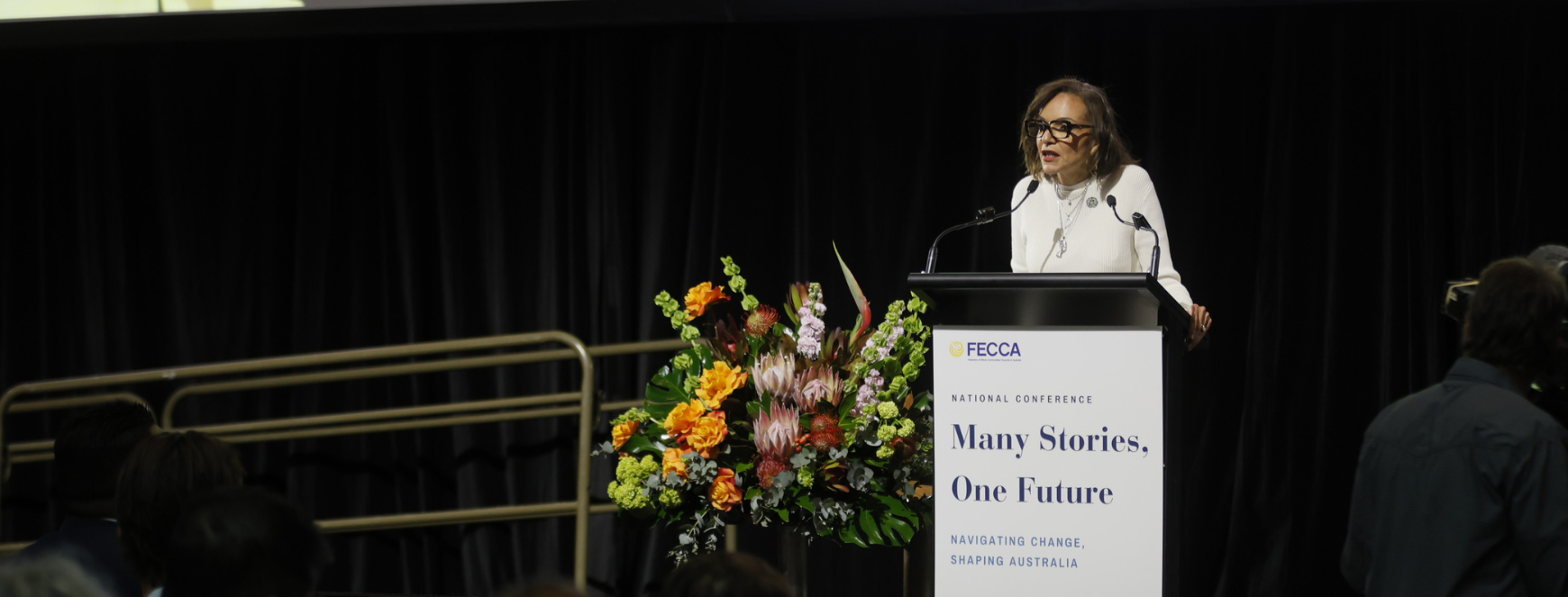
When I thought about what I was going to say, and how can I talk about multiculturalism and what it all means in a short space of ten minutes, I thought, we’ll do this by going through the conference theme.
Many stories, one future. In 1973, Al Grassby who as the Minister for Immigration during the Whitlam Government, got rid of the final vestiges of the White Australia policy, departing from history and setting a new paradigm.
Frank Galbally oversaw the Galbally review, which laid the foundation stone for the establishment of FECCA in 1979.
1993, Nick Bolkus, the first Greek Australian Immigration Minister under the Keating Government, established the Refugee Review Tribunal and that provided crucial human rights safeguards, ensuring that asylum seekers were not mistakenly returned to countries where they faced persecution or danger.
2024, Hass Delal, a life dedicated to multiculturalism through various roles, leads the Multicultural Framework review towards fairness. Multicultural Australia, a first review of its kind in 50 years.
And for my own story, those who have influenced me, who have had a deep impact on my thinking, on multiculturalism. The late Professor Laki Jayasuriya, the architect of the Charter of Multiculturalism.
My dear friend and mentor, the late Dr Leela De Mel. You’ll forgive me getting a little bit emotional when I speak about these people and the profound effect that they had on me.
And the not so late and still going, Suresh Rajan and Ramdas Samkaran, all have had an incredibly profound influence on me and on my thinking about multiculturalism. Many stories that have progressed multiculturalism in Australia.
My family, Hamida, Mahmoud, Rhonda aged three, and a rather chatty little dark eyed girl named Azza, arrived at the Bonegilla migrant training camp in Albury-Wadonga on a chilly June day in 1969. A few weeks later, Mahmoud, an engineer by qualification, was assigned work in a factory in Sydney and he left the migrant training camp to set up home for us, renting a room with a Greek family in Marrickville, the Prime Minister’s electorate. First stop Marrickville.
My mum, my sister and I soon followed. We lived in Sydney’s inner west. I went to my first school in Marrickville. Mahmoud eventually became a bus driver, never working in his field of engineering. Hamida an aged care nurse, and Azza, well you know her story.
Today, that family has grown to consist of people with a cultural heritage and origins from Egypt, Canada, Bosnia, Burma, Somalia, Mauritius, New Zealand, Ireland and First Nations.
All Australian. Every single one of us.
Navigating change, shaping Australia, I don’t have to tell anyone in this room that migrants have been shaping this nation for generations, and at times this truism has been questioned.
It’s been challenged, or indeed completely deleted from the telling of our Australian story, primarily by those who seek to divide, by perpetuating and imagined indeed mythical constructs of Australia as a monocultural, racially pure nation in Australia that never existed.
Because diversity is not new. It’s etched in our history, in over 60,000 years of our first national peoples who practised different cultures and spoke different languages. It’s etched in our landscape, from the snowcapped mountains to the red earth centre, to tropical rainforests to pristine coastlines.
And it’s etched in the Australia that we see today, the Australia that we see in this room as we navigate, change and shape this modern, multicultural nation.
We are not just charged, we are charged with reimagining, reimagining multiculturalism, not just as a concept that’s able to underpin a developing discourse of nationhood, but as a reality that enables the longing that pushes back against division and that presents us to our region and to our world.
Our substantive multiculturalism, one that moves beyond what I call the three ‘Cs’, costume, cuisine, and celebration.
Those things are important. They are important as bridges and conduits to bring people together and give everybody a stake in multiculturalism. But we also need a multiculturalism that doesn’t just celebrate diversity, but that recognises that our diversity is who we are and underpins policy, underpins service delivery, and underpins nation building.
That starts with representation.
As the Prime Minister mentioned, this Labor Government is the most culturally and linguistically diverse government in the history of this nation, led by a Prime Minister named Albanese, who had the conviction and the foresight to bring multicultural affairs into the cabinet room, and to oversee the establishment of the office for Multicultural Affairs.
My friends, this is not just representation, it’s meaningful participation.
And it has a ripple effect because it’s a dark eyed girl seeing herself in the Parliament. It’s a young boy named Zhi or Basem, seeing himself debate policy, and it’s the young boy with an Italian name becoming the Prime Minister of Australia.
It’s a young girl in Malaysia seeing herself lead Australia on the world stage.
What is before us is a moment. It’s a moment because of a few things. It’s a moment because of the hard work of the people in this room and those who are with us in spirit.
Who have advanced the cause of multiculturalism so that the migrant daughter of a bus driver, the son of a single mother, the child of Indian migrants, can sit in this Parliament.
But it’s a moment that calls us to think deeply about them, to think about how, despite all the challenges of the past, multiculturalism has necessarily developed beyond what was first articulated in 1973, developed into a concept that enables democratic participation for all Australians, and that must continue to develop so that it has meaningful and meaning to second, third, fourth, fifth generation Australians and beyond.
A multiculturalism that recognises difference as a hallmark of democracy, and that sees citizenship as a practice and as a country where all people are afforded the means and the opportunity to participate in social, economic and political spheres.
So, I come back to the beginning, to our many stories, to your stories, to my story, to the Prime Minister’s story.
Stories of struggle. Stories of success, but importantly, stories of nation building. And my friends that projects never ends.
The Australian story is still evolving, and the role that FECCA plays in ensuring that our multicultural communities and the contributions that they make are not mere footnotes in that story, is as pivotal today as it was in 1979.
I’m thanking you for everything you’ve done to bring us to where we are today, to thank those giants who led the way, who had those conversations when those conversations were hard to have.
There are challenges ahead, but I firmly believe that we face these challenges before.
And you know what, together we will rise above again.
Thank you.
