
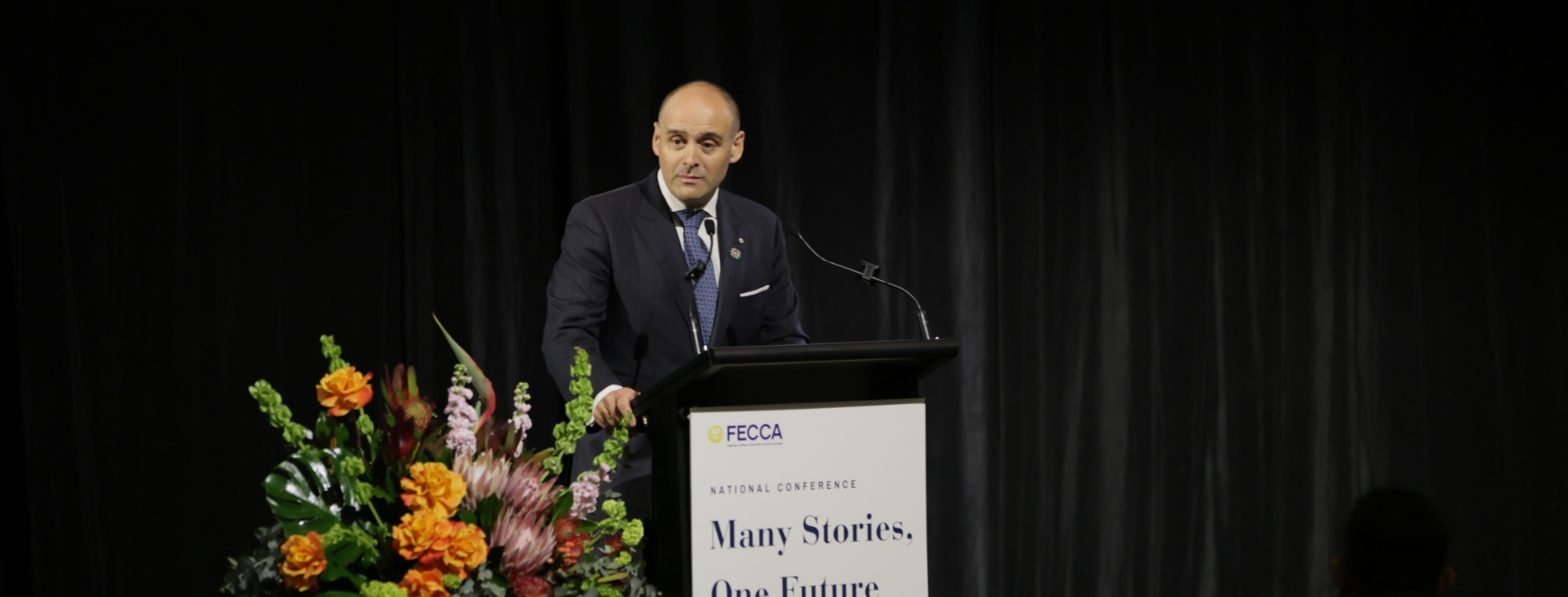
Thank you, Prerana. Good morning, everyone. Prime Minister, Minister Aly, distinguished guests.
I acknowledge the Ngunnawal people as Traditional Custodians of the land on which we meet, and the Ngambri people and other peoples and families with traditional connections to this land. I pay my respects to Elders past, present and emerging, and thank Aunty Serena Williams for her Welcome to Country.
Our conversations about belonging take place on First Nations Country. That brings a responsibility to listen and support justice for Aboriginal and Torres Strait Islander peoples.
Welcome to the FECCA National Conference 2026.
Since its establishment in 1979, following the abolition of the White Australia policy, FECCA has brought the voices of multicultural communities to the national conversation. As we approach our fiftieth anniversary, we have much to be proud of – and much still to do.
Even through the bitter divisions of the Whitlam and Fraser years in the 70s, Labor and the Coalition found common ground on multiculturalism. They disagreed fiercely about who should govern Australia, but shared a commitment to building a country where race would no longer determine who could become Australian.
On 31 October 1994, Prime Minister Paul Keating opened FECCA’s national office in Deakin, here in Canberra. He described Australia’s multicultural society as “one of Australia’s great contemporary achievements” and recognised FECCA’s contribution to our national life.
We inherit a legacy built by people who insisted that their families deserved a fair chance and a voice in decisions affecting their lives. They established community organisations across states and territories, often volunteering after a full day’s work. They helped new arrivals find their feet and pressed governments to make public services accessible to everyone – they fought for a fair Australia.
Postwar migrants brought the commitment and work ethic to build better lives for their families and a more prosperous Australia. We see that same commitment in migrants who choose to call Australia home today.
Many of those who have carried this work forward are here today. Thank you.
More than thirty years later, Keating’s words demand something of us.
We are custodians of Australia’s multicultural legacy. We owe it to those who came before us, and to the next generation, to protect what they built and make it stronger.
That means standing together when communities face racism. It means making room for new voices, especially young people whose experience of Australia differs from that of their parents. And it means holding ourselves accountable for delivering change.
This is where the promise of multiculturalism must be kept.
The responsibility for a strong multicultural Australia belongs to all of us – in this hall and in the parliamentary chambers around us.
Our federation must continue to bring community experience into those decisions.
I thank FECCA’s Board and our members for the knowledge, experience and leadership that make this possible.
Prime Minister, thank you for joining us. We appreciate the Government’s support for FECCA and its commitment to multicultural Australia. We look forward to continuing that work together.
I also thank our Conference Partner, CommBank, and our Official Media Partner, SBS, for their support.
Over the coming days, let us meet the challenges together, stand firm in the face of criticism and scrutiny, and work for an Australia where we all belong.
The generations before us gave us a stronger, fairer Australia. The next generation should be able to say the same of us.
When we talk about Australia’s future, we should speak confidently about the part multicultural communities will play in it.
Amid the divisive debate about migration, their contribution to Australia’s economy cannot be denied.
Multicultural Australians help keep our economy running across health care, IT, banking, hospitality and construction. They are our doctors, nurses, engineers, accountants and lawyers, alongside workers in essential roles throughout the country.
To put evidence behind that contribution, FECCA commissioned independent research surveying 500 business leaders across Australia.
The findings are clear.
Eighty-seven per cent say multiculturalism has had a positive impact on Australia’s economy over the past 50 years and will continue to do so. Eighty-five per cent recognise its importance in helping businesses access skilled workers.
These leaders make decisions about Australia’s economic future: its skills needs, investment and growth. Their message deserves to be heard.
In the coming months, we will launch the full FECCA Business Leaders Survey report. We will work with our members, the multicultural sector and industry to bring this research to life through the stories of migrants building businesses, creating jobs, filling critical roles and strengthening regional communities.
Along with the cultural and societal richness that multiculturalism brings to Australia, we must now also remind those who would deny it that migrants makes a profound economic contribution to this country.
It is now my great honour to introduce the Prime Minister of Australia.
Ladies and gentlemen, please welcome the Honourable Anthony Albanese MP.
