
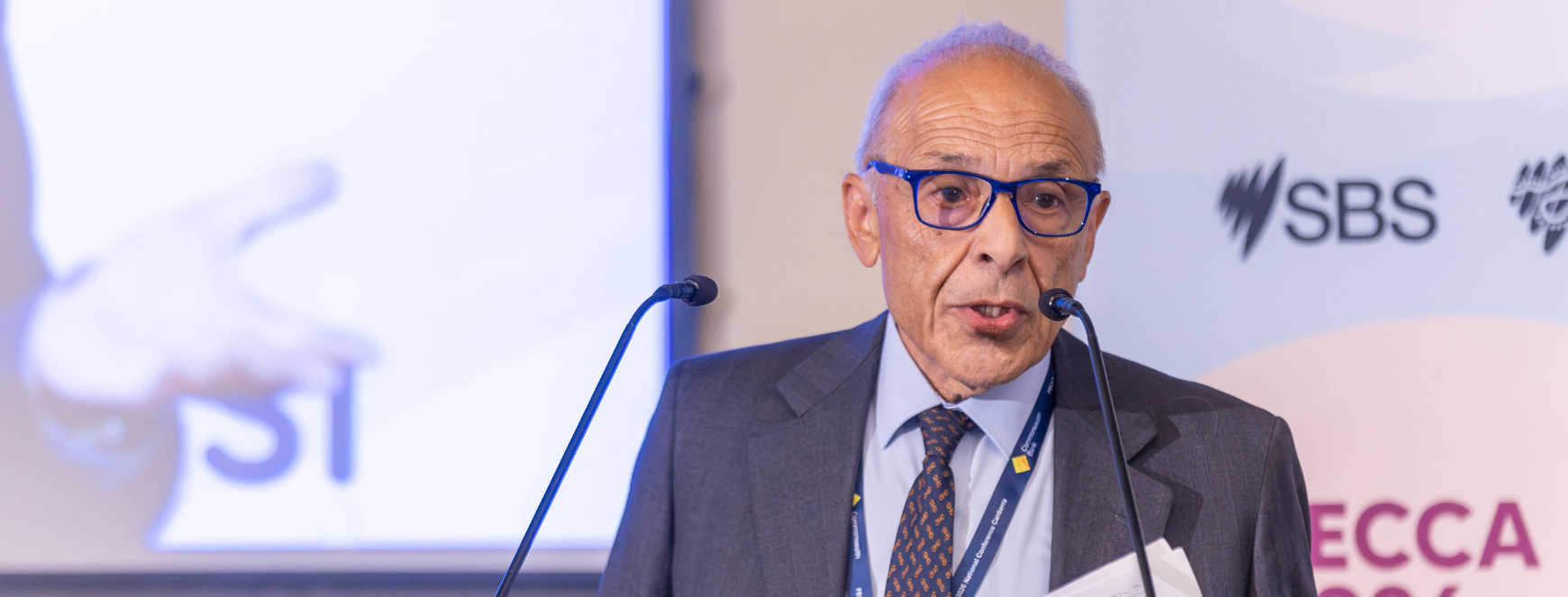
Good morning, everyone.
I acknowledge the Traditional Custodians of the land on which we meet, the Ngunnawal and Ngambri peoples, and pay my respects to Elders past and present. I also acknowledge the Aboriginal and Torres Strait Islander people joining us today.
Thank you to FECCA for bringing us together to consider identity, belonging and the way forward; and whether we have a genuine sense of place in Australia we share.
That brings us to the questions at the heart of this plenary. Who are we? Where do we belong? And where do we go from here? We addressed this topic in many ways yesterday. Let me make a few observations before we lead into the panel discussion.
So, let’s go back to foundations.
Australia’s problem is not that we chose multiculturalism. The problem is that we have sometimes stopped short of the second half of the accord: building a strong, shared civic identity around it.
The data doesn’t support the idea that Australians have broadly rejected multiculturalism at all.
As we know, the 2025 Scanlon survey found that 83 per cent agreed that multiculturalism had been good for Australia. I am not aware of any other social policy with such a level of acceptance.
But there is a genuine problem underneath the political noise.
The same Survey also found that national belonging and pride have declined from earlier levels, while economic and housing concerns and global conflicts weigh on social cohesion.
And at the same time, neighbourhood-level connections remain relatively strong.
So, my answer to this is maybe we need to change the question. Instead of asking “How do we make different groups feel included?” We should ask: what are we asking all Australians to belong to?
A country needs more than a collection of demographic identities. Eventually there has to be a civic identity: a set of things we believe we share despite our differences.
And I don’t think that requires choosing between Indigenous heritage, British institutions, migration or multiculturalism. Australia’s own Multicultural Framework Review explicitly describes national identity as something that has developed from First Nations traditions, British institutions and successive waves of migration.
I would build identity around fairness, freedom, democracy, equal citizenship, human rights, mutual respect, personal responsibility and the rule of law. A willingness to contribute. And the belief that someone else’s success does not diminish yours.
These principles must mean something in everyday life. Fairness must be visible in the workplace. Equal citizenship must be evident in how institutions treat people. Democracy must include the opportunity to be heard, to disagree and to help shape decisions.
A shared civic identity is credible only when people can see its principles at work.
And that commitment works both ways.
You cannot tell someone that they will never be genuinely Australian because of their surname, religion, skin colour or birthplace, and then ask why they do not feel they belong.
Nor can any of us claim this society’s freedoms while refusing to respect others’ equal freedoms.
We should expect everyone to respect our laws and democratic institutions, gender equality, diversity, and freedom of religion, including the freedom not to believe. That includes participation in the broader community and commitment to Australia and its people.
Government must make sustained participation possible.
Responsibility without opportunity is an incomplete bargain.
These expectations apply to everyone, whether their family arrived recently or has been here for generations. There should be no hierarchy of citizenship.
I’d also stop treating difference as the destination.
Difference is the starting point.
The destination should be belonging.
You don’t need Australians to become culturally identical. You need them to feel that, despite enormous differences, they are part of the same national project.
And the evidence gives us a clue about how to achieve that. People who experience strong neighbourhood cohesion and participate in community life are substantially more likely to feel they belong. It’s the work you do out there every day.
So, while a campaign about diversity and the benefits of a managed migration program would be helpful to inform all, what’s more important is that we need more sporting clubs, volunteering, local organisations, shared schools, community events, civic participation, apprenticeships, workplaces and public spaces where people actually can live alongside and interact with one another.
People should be able to retain their heritage and be unequivocally Australian. They should also have an equal opportunity to help shape what Australia becomes next.
In other words: Don’t just tell Australians that we belong together. Give us reasons to belong together.
To me, that’s the heart of the answer.
Australia doesn’t need to choose between diversity and identity. We need to build an identity strong enough to contain our diversity.
The most useful way to put it is that Australia hasn’t necessarily gone wrong because we became more diverse; we’ve struggled because we haven’t developed a sufficiently compelling shared story alongside that diversity.
I see three places where we need to get the debate back on track.
First, we have too often turned Australian identity into a culture-war question. Preserving what is valuable about Australia and valuing its people’s diversity are compatible ambitions.
For years, the argument has tended to bounce between:
• Australia must preserve its traditional identity.
• Australia must become more inclusive and recognise diversity.
Those aren’t necessarily opposing propositions.
The harder task is creating an identity that says:
You don’t have to stop being Chinese, Lebanese, Greek, Indian, Aboriginal, English, Jewish, Vietnamese or anything else to be Australian. But being Australian has to mean something shared.
Australia’s own multicultural framework recognises that national identity is fluid rather than permanently fixed, while also acknowledging the importance of a shared sense of belonging.
Our national story must recognise the unique place, rights and continuing cultures of Aboriginal and Torres Strait Islander peoples, whose relationship to Country and their experiences of dispossession cannot simply be folded into a story of cultural diversity.
Acknowledging injustice and unfinished responsibilities does not diminish Australia. It gives us a more honest foundation on which to build its future. We can value our democratic institutions, recognise how migration has transformed the country, and take pride in our achievements while accepting that there is more to do.
Multiculturalism and social cohesion are closely interconnected, but they ask different questions.
Multiculturalism concerns recognition, equal rights, the freedom to retain our heritage, obligations and responsibilities.
Social cohesion asks whether we trust one another, feel we belong, and can work together within shared institutions.
We need both!
Second, we have allowed economic anxiety to become an argument about who belongs.
History should teach us the danger of turning insecurity into suspicion of people who are different. People worried about rent, work or their children’s prospects deserve serious answers. Migration levels, housing supply, infrastructure and workforce needs are legitimate matters for democratic debate.
But a debate about how many people Australia can responsibly accommodate must not become a debate about whether Australians from particular backgrounds are really Australian.
If we answer economic insecurity with cultural blame, we leave the insecurity unresolved and add division to it. Political leadership should offer a credible way forward, rather than an ever-changing list of people to blame.
Third, we have forgotten that belonging has to be experienced, not simply announced.
You cannot build a shared identity by demanding that everyone tell the same story about the past.
Australians should be able to say simultaneously:
• Indigenous Australians have an ancient connection to this continent.
• British institutions profoundly shaped modern Australia.
• Immigration transformed the country.
• Australia’s history contains serious injustice.
• Australia has also built an extraordinarily successful democratic society.
Government needs a clear vision, coordinated action and accountability. Towards Fairness, Rebuilding Trust, and other reports draw on extensive consultations and set out substantial recommendations on multiculturalism, racism, and inclusion.
These reports provide a roadmap – not perfect, but a good one – that shows we know much of what needs to be done. The failure has been in implementation. Will the recommendations from the Royal Commission into antisemitism and social cohesion meet the same fate?
So, the task now is implementation: what will be delivered, who is responsible, and how will we know it is working?
Community organisations must build bridges beyond their memberships. Service providers must make equity a reality. Our public institutions, including parliaments, councils, the judiciary, public boards and the public service, should by now reflect the diversity of the people they serve. Academics must help us understand what works. Political leaders must model the respect they ask of the public.
We need partnerships with business, unions, schools, sport and faith communities. The case for a confident multicultural Australia should be made across Australian society.
Don’t just tell Australians that we belong together. Give us reasons to belong together.
Finally, I don’t think the problem is necessarily that Australia has become too diverse or not diverse enough.
The problem is that we haven’t been sufficiently confident about the “we” in “we are Australians.”
And that is a question worth asking.
What if Australia’s real failure isn’t multiculturalism—but our failure to build a strong enough shared identity around it?
That is a much harder question for both sides of the debate to answer.
